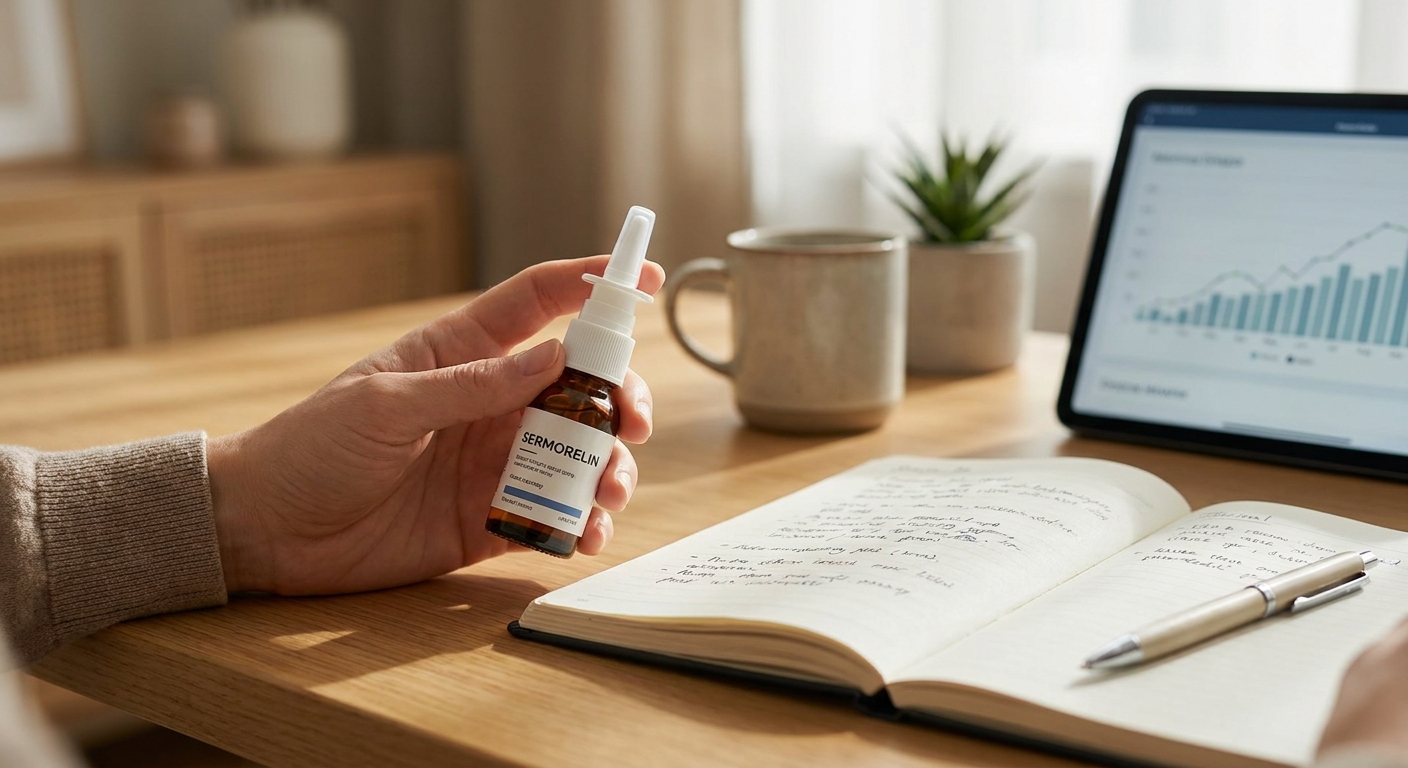
Sermorelin nasal spray is supposed to stimulate your pituitary gland to release more growth hormone, but the honest answer to "does sermorelin nasal spray work" depends on how it's dosed, how consistently you use it, and whether you're tracking anything at all. Here's how to tell if it's actually doing something in your body versus just costing you money every month.
TL;DR
Sermorelin nasal spray works by triggering GHRH receptors in the pituitary, but nasal absorption is inconsistent compared to injectable sermorelin, so tracking matters more here than with other delivery methods. Look for three signals over 8-12 weeks: deeper sleep (fewer 3 a.m. wake-ups), a measurable IGF-1 change on a follow-up blood panel, and shifts in body composition rather than scale weight. If none of those three move after three months, the nasal delivery likely isn't hitting therapeutic levels for you, and it's worth talking to a clinician about an injectable protocol instead. Verdict: track it with labs, not vibes — sermorelin nasal spray can work, but only consistent monitoring tells you if it's working for you specifically.
Why this matters
Sermorelin isn't a stimulant. There's no jolt, no appetite suppression you'll feel within an hour, no immediate marker like a caffeine buzz. Growth hormone secretagogues work on a delayed, cumulative curve — most people who quit early do so because they expected a same-week effect that peptides like this don't produce.
The bigger issue with nasal spray specifically is bioavailability. Nasal mucosa absorption is more variable person to person than a subcutaneous injection, which means two people on the identical dose can get very different serum exposure. That's exactly why passive guessing ('do I feel different?') fails and objective tracking wins.
What you'll need
- A baseline IGF-1 blood test taken before you start (or within your first week)
- A follow-up IGF-1 panel at 8-12 weeks — same lab, same time of day if possible
- A sleep tracker or simple sleep log (wake-ups, time to fall asleep, subjective rest score)
- A body composition method: tape measure, calipers, or a scan — not just a bathroom scale
- Consistent nightly dosing at the same time, ideally on an empty stomach
- Access to a licensed clinician who reviewed your prescription, so dose adjustments are actually possible
Sermorelin nasal spray protocols from a telehealth provider like Rebody Health typically pair the prescription with clinician check-ins, which is the piece most self-directed users skip and then wonder why they can't tell if anything changed.
The steps
1. Get a baseline IGF-1 test before you start
This single number is your control group. Growth hormone itself pulses and is nearly impossible to measure meaningfully with a random blood draw, but IGF-1 reflects your average GH output over the prior 24 hours and is stable enough to compare across months. Skip this step and you're comparing 2026 to a guess.
Common mistake: testing IGF-1 after you've already been on sermorelin for six weeks, which leaves you with no true "before" number to measure against.
2. Dose at the same time every night for at least 8 weeks
Growth hormone secretagogues work with your natural nocturnal GH pulse, which peaks in the first few hours of deep sleep. Dosing 30-60 minutes before bed, on an empty stomach, aligns the spray with that window. Inconsistent timing — some nights at 9 p.m., some at midnight — flattens the effect and makes results harder to attribute.
Common mistake: eating a meal right before dosing, which blunts GH release and makes an otherwise working protocol look ineffective.
3. Track sleep quality, not just sleep hours
Better sleep architecture is usually the first thing people notice on sermorelin, often within 2-4 weeks. Look for fewer middle-of-the-night wake-ups and less time to fall asleep, not just total hours logged. A wearable sleep score or a simple 1-10 rating written down each morning is enough — you're looking for a trend, not a single good night.
Common mistake: dismissing a subtle improvement because you expected something dramatic. Sermorelin's sleep effect is usually gradual, not a light switch.
4. Recheck IGF-1 at week 8 to week 12
This is the objective checkpoint. A meaningful upward shift from baseline — clinicians generally look for a change your provider flags as clinically relevant relative to your starting number — tells you the nasal delivery is reaching your pituitary at a working dose. A flat or negligible change after 12 weeks is the clearest signal the spray isn't absorbing well for you.
Common mistake: testing at a different lab or a different time of day than your baseline, which introduces enough variance to make the comparison meaningless.
5. Measure body composition monthly, not weekly
Sermorelin's downstream effects on lean mass and fat distribution take longer to show than sleep or labs — usually 8 to 16 weeks. Weekly scale weight is noisy and will discourage you before real change shows up. A tape measure at the waist, or a monthly scan, filters out water-weight noise and shows the actual trend.
Common mistake: judging progress by scale weight alone, when the more relevant change is often a shift in waist circumference or a body fat percentage that a bathroom scale can't detect.
6. Log energy and recovery subjectively, every day
Many users report better next-day recovery from workouts and steadier daytime energy before labs or measurements catch up. A one-line daily note (energy 1-10, soreness 1-10) creates a paper trail that's easy to forget once you're three months in and trying to remember if week two felt different from week ten.
Common mistake: relying on memory instead of a log — most people underestimate early gains and overestimate how long it took to notice them.
7. Reassess with your clinician at the 12-week mark
Bring your sleep log, your two IGF-1 values, and your body composition notes to this check-in. A clinician reviewing all three data points can tell you whether the nasal spray is working at your current dose, whether the dose needs adjusting, or whether nasal delivery isn't a good fit for your absorption and an injectable sermorelin protocol makes more sense.
Common mistake: stopping therapy on your own after a slow first month instead of bringing the data back for a dose review.
Troubleshooting
- IGF-1 barely moved after 12 weeks: This is the strongest signal that nasal absorption isn't clearing a therapeutic threshold for you. Ask your clinician about a dose increase or switching to injectable sermorelin.
- Sleep improved but IGF-1 didn't: Sleep quality can improve from routine and consistency alone, so don't treat it as proof the peptide is working — wait for the lab confirmation.
- Nasal irritation or drip after dosing: Some users lose a portion of the dose to drainage, which lowers effective absorption. Report this to your clinician — technique adjustments or a switch in delivery method can fix it.
- No changes in body composition despite good IGF-1 numbers: Growth hormone signaling supports composition change, but it's not a substitute for training and protein intake. Check the other variables before blaming the peptide.
- Inconsistent daily dosing: If you've missed more than a few doses a week, your data isn't a fair test yet. Re-baseline once you've hit 90%+ adherence for 8 weeks straight.
- Feeling worse (headaches, flushing): These are known but uncommon reactions to GHRH analogs. Flag them to your prescribing clinician promptly rather than pushing through.
Tools and resources
- A licensed telehealth provider that reviews labs and adjusts dose, not just ships product
- A basic sleep tracker (ring, watch, or a phone alarm log)
- A tape measure and a scale that also estimates body fat, or access to a periodic scan
- A lab that can run IGF-1 panels and compare against your baseline
- A detailed breakdown of how sermorelin nasal spray works for energy and anti-aging use, including what the delivery method changes about absorption and routine
What to do next
Once you've got 12 weeks of data — two IGF-1 values, a sleep trend, and a body composition check — the next decision is whether to stay on nasal delivery, adjust the dose, or move to an injectable form of sermorelin that removes the absorption variability entirely. That conversation belongs with the clinician who prescribed it, not a forum thread.
FAQ
Does sermorelin nasal spray work as well as injections? Nasal spray can work, but absorption through nasal mucosa is more variable than a subcutaneous injection, which is why tracking IGF-1 and adjusting dose with a clinician matters more with this delivery method.
How long before sermorelin nasal spray starts working? Most users notice sleep changes within 2-4 weeks, but the clearest objective signal — an IGF-1 shift — typically shows at 8-12 weeks, not sooner.
What's a normal IGF-1 increase on sermorelin? This varies by baseline and dose, which is exactly why a personal before-and-after comparison matters more than a generic target number — ask your clinician to interpret your specific values.
Can I tell if it's working without blood tests? Sleep quality and recovery are useful early indicators, but they're subjective and can be influenced by other lifestyle changes. Labs are the only way to confirm the peptide itself is doing the work.
Is sermorelin nasal spray safe to use long-term? Sermorelin has a long clinical track record, but any peptide therapy should be monitored by a licensed clinician with periodic labs, especially past the 2026 first-year mark of use.
Why isn't sermorelin nasal spray working for me? The most common reasons are inconsistent nightly dosing, dosing after a meal, nasal drainage reducing the effective dose, or an absorption rate that's simply lower for your physiology — all fixable with clinician input.
Should I switch from nasal spray to injectable sermorelin? If 12 weeks of consistent dosing shows no IGF-1 movement, switching to an injectable form is a reasonable next step, since it removes nasal absorption as a variable entirely.
Does sermorelin nasal spray help with weight loss directly? Sermorelin isn't a weight-loss drug on its own — its role is growth hormone support, and any composition change comes indirectly through improved sleep, recovery, and lean mass over months, not weeks.
One last thing
The detail most people miss: the two most common reasons sermorelin nasal spray "doesn't work" have nothing to do with the peptide itself — they're eating within an hour of dosing and never getting a baseline IGF-1 test before starting. Fix those two habits before you write off the whole protocol in 2026.